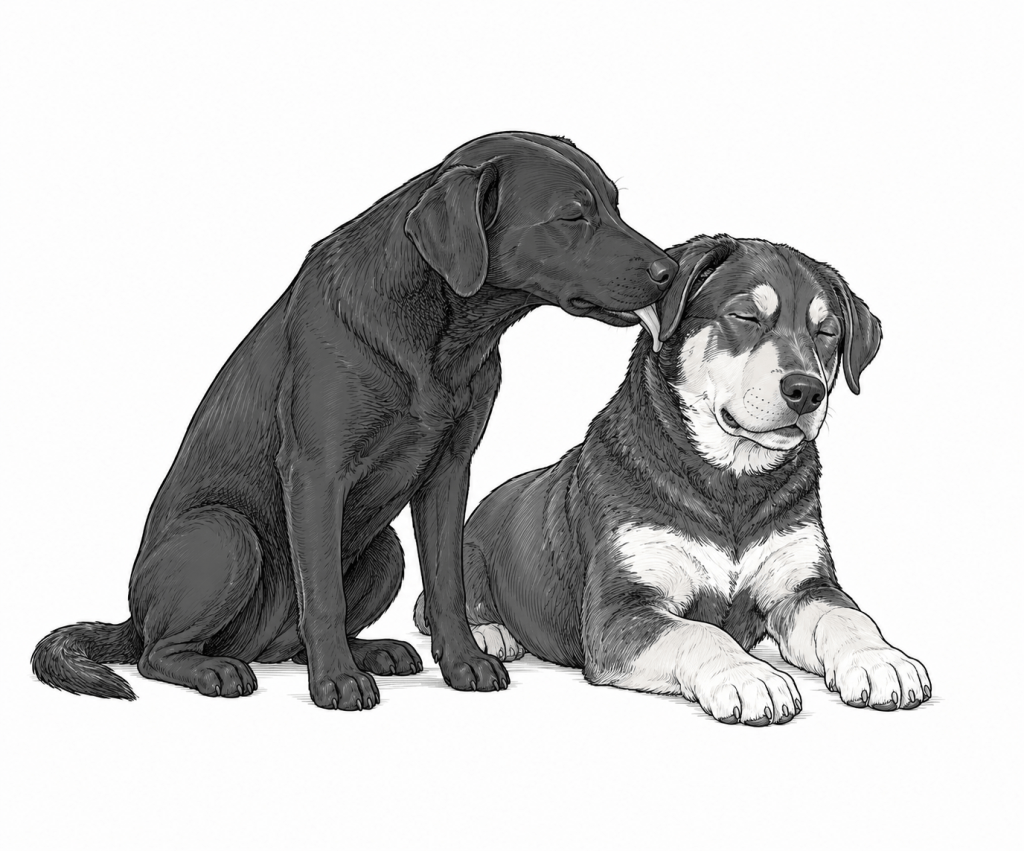
One of the most distinctive parts of the Mother Dog Method is what Ken Griffiths describes as the “Mother Dog Lick” — often referred to simply as “lick the neck.”
It is not literal licking with your tongue.
It is not petting.
It is not affection for affection’s sake.
It is a deliberate, calming touch used to communicate something many anxious, reactive, and overstimulated dogs are desperate to feel:
You are safe. I’ve got this. Now just relax and focus on my affection.
In the Mother Dog Method, “lick the neck” is used to help a dog come down out of vigilance and back into regulation. It is one of the clearest physical ways to tell a dog they are no longer responsible for managing the world around them. This method is part of the broader sequence of calming, guiding, and re-establishing trust through clear physical communication.
What “Lick the Neck” Actually Is
“Lick the neck” is a slow, intentional touch applied with the fingertips along the side of the dog’s neck, just behind the jawline.
This is not random petting.
This is one of the areas dogs naturally use for social regulation and communication. This touch is positioned as a physical signal of reassurance and nervous system downshift — not reward or indulgence. A Mother Dog does not reward her puppies with treats, she thanks them with acceptance and affection by licking their neck.
The motion is usually:
- slow
- light to moderate pressure, most of the time you are barely touching their fur.
- one-directional. You only touch as you move your fingers towards you.
- deliberate with no hesitation
- calm
- gentle
Why It Works
Most reactive dogs are not simply “misbehaving.”
They are activated.
Scanning.
Bracing.
Carrying too much. They feel responsible for a job they were not born to do.
Many are operating in a state of chronic vigilance, and their nervous systems are constantly checking for what might go wrong next. They are the ‘over thinkers’ of the dog world.
The Mother Dog Method is built on the idea that many dogs escalate because no one is blocking the energy from increasing, and feeding in the calm relaxed energy instead.
“Lick the neck” works because it is not just touch. It is communication.
It tells the dog:
You have nothing to worry about.
For many dogs, this creates a visible shift:
- the jaw softens
- the fur and skin relax
- the eyes soften and blink
- the breathing slows
- the body relaxes
- scanning slows
- tension is released
When you get this touch right, it is truly magic. You are witnessing in real time the nervous system response to the calm, intentional and meaningful touch of a puppy’s Mother Dog. They experience this touch from the day they were born, and they will never forget it for the rest of their life.
Why the Neck?
The neck is a socially meaningful area for dogs.
It is vulnerable.
It is intimate.
It is where dogs often exchange information with each other physically.
A dog knows what another dog’s intention is by the angle to which the other dog approaches their neck.
Mother Dogs naturally use their mouths and muzzle around the neck, face, and jawline of puppies to guide, settle, and regulate them. This contact is not aggressive when corrective, it is assertive. It is directional, calming, and relational.
The “lick the neck” gesture is meant to replicate that same kind of communication in a way a human can safely and appropriately replicate.
That is why the touch is placed at the lower side of the neck, rather than on the top of the head, shoulders, back, or rump, where humans tend to pet reflexively. Touching a dominant dog in these areas is seen as a dominance challenge and is the main cause for dog bites across all breeds; someone tried to touch a dog on the top of the head, shoulders, back or rump when the dog clearly didn’t want them to.
Finally, and of the utmost importance, DO NOT look your dog in the eye when you lick their neck. A Mother Dog can not lick her puppy’s neck and look them directly in the eye at the same time. When you do, you are giving the dog mixed signals. You are giving affection with your fingers, but you are challenging with your eyes, even if you think you are projecting love. Eye contact trumps everything else, and if that dominant dog does not fully trust and respect you, they will, more often than not, bite you. If you want to look at your dog while licking their neck, you have to close and soften your eyes.
What The Neck Lick Is Not
This is where people often misunderstand the technique.
“Lick the neck” is not:
- casual petting
- babying
- repetitive soothing
- appeasement
- affection layered on top of arousal
If the dog is still highly activated, frantic, or escalating, affectionate petting often adds stimulation rather than reducing it.
This is why timing matters.
In the Mother Dog Method, touch has different purposes:
- correction redirects focus to you
- guidance redirects movement
- affection reinforces calm, relaxed energy, thanks appropriate behaviour, consoles nervous or fearful energy, regulates emotions, and calms the nervous system.
It is not used to placate chaos. It is used to deepen calm once the dog is beginning to come out of it.
When is Very Important
This is not the first step.
“Lick the neck” is not how you interrupt a dog in full escalation.
You do not use it while the dog is:
- lunging
- barking
- spinning
- fully over threshold
- actively rehearsing aggression
It comes after interruption.
After space.
After the dog is focused on you.
In practical terms, this means:
- interrupt fixation – Tss & snap your fingers or lead
- create space – move the dog away from the fixation using your body language
- reduce tension – never have tension on the leash, or in your body
- guide the dog back toward regulation by asking the dog to sit and wait until the dog maintains eye contact with you. “Yes Mom, what do you want me to do?”
- then use “lick the neck” to thank and to deepen calm. “I dont want you to do anything. I just want to relax and let me show you how much I love you by licking your neck.”
This is why it works best as part of the larger Mother Dog sequence, not as a standalone trick.
How to Know it is Working
When using this touch, you are watching for the dog to begin releasing tension and relaxing.
Signs the dog is relaxing often include:
- blinking
- swallowing
- exhaling
- jaw softening
- ears relaxing back
- head lowering
- gently leaning
- reduced scanning
- tail lowering to the straight down ‘relaxed position
Those are signs the dog is coming out of vigilance and beginning to trust the moment.
That is the entire point.
Common Mistakes
1. Using It Too Early
If the dog is still highly activated, this often adds stimulation instead of calm. Never touch a dog with your hands to give affection until the dog is doing what you are asking them to do. If you want your dog to be calm and relaxed, you have to wait until til they are calm and relaxed before you give the affection. The trick is learning how to get your dog to be calm and relaxed in the first place. You will never see a treat make a dog calm and relaxed, at minimum a treat makes a dog alert, at worst is makes a dog highly energetic, reactive, or aggressive.
2. Petting Instead of Regulating
Fast, repetitive, emotional petting is not the same thing.
This is slower, clearer, and more intentional. Affection with a purpose. You are feeding in the calm and relaxed energy you want tour dog to be.
3. Using Too Much Pressure
This is not restraint.
The goal is calm contact, not physical control.
4. Using too much energy.
Dog owners have been told for decades that they must reward their dog with high energy praise and affection. What happens when you do that? Your dog becomes more excited and thus reactive.
This where a distinction needs to be made between ‘dog training‘ and ‘dog behaviour‘. Dog training is about high energy praise and rewards for completing a specific action or task. Dog behaviour is about creating a calm and relaxed mind thanked with calm affection. Once a dog is calm, you can train them to do anything you want. If your dog is in a high energy or focused state of mind and the dog will not focus on you or listen to you, you can not ‘train’ the dog to do anything. Once you have created the calm and relaxed mind, now the dog is focused on you and is listening to you, so now you can train them or teach them. Scientifically speaking, a dog’s higher learning and decision-making systems become far less accessible when the nervous system is stuck in survival mode. Until a dog is emotionally regulated enough to feel safe, calm, and connected, meaningful learning and behavioral rehabilitation become extremely difficult — not because the dog is unwilling, but because the brain is prioritizing protection over learning.